Follow us


Description: This program is from MIT and it's called "Assist Sketch Understanding System and Operation".
Design Simulation Technologies develops, markets, and supports software products used by students, educators, and professionals to learn and teach physics principles and to use these principles to build virtual models of mechanical designs.
MIT Assist Sketch Understanding System and Operation works by sketching a simple mechanical device onto the drawing board and then demonstrating how the system understands the sketch through movement.
Draw objects like ramps, carts, wheels, baskets with springs, then hit run and this program MIT is developing will process physics-based simulations on what you drew. I could spend hours messing with something like this, I need it! Give it to me, MIT!! :-)
Design rationale is often not recorded in mechanical engineering designs because it is not convenient to stop the design process to record every design decision that is made. Designing directly on the computer could assist the process of design rationale capture. At the very least a computer design tool could record all the changes made to a design over its lifetime.
Unfortunately, current computer-based design tools for mechanical engineers are not tailored to early stages of design. Most designers use pencil and paper at first, and input their design into CAD systems only after it is nearly complete. The tradeoff between the ease of drawing and the precision of a CAD tool is too great for engineers who are just sketching out rough designs.
We aim to create a tool that allows the engineer to sketch a mechanical system as she would on paper, and then allows her to interact with the design as a mechanical system, for example by seeing a simulation of her drawing. We have built an early incarnation of such a tool, called ASSIST, which allows a user to sketch simple mechanical systems and see simulations of her drawings in a two-dimensional kinematic simulator.
Even with advanced design tools, the design process typically produces a description of the desired artifact, but leaves little or no indication of the design rationale. We end up knowing what was designed, but often have no idea why it is the way it is, what motivated the particular design, what alternatives were considered and rejected, etc.Why is this so? We believe one important answer lies in the difficulty of producing rationales and the perception of their worth. Simply put, design rationales appear, especially to designers, to be both uninteresting and more trouble than they are worth. The exciting part is designing the artifact; documentation is a mundane task. Documenting is also a lot of work, and the value in doing it typically accrues to someone else: the designer knows how the artifact works and why, so writing it all down typically provides little personal benefit. It's those who come after who get the benefit, hence the feeling among designers that rationales are more trouble than they are worth.
The irony is that designers are often delighted to describe - to one another at least - the more interesting parts of their design. We just don't know how to make it as much fun to describe those things to a design rationale capture tool.
Numerous attempts have been made to create rationale capture tools; one frequent complaint about them is that they can make the design process more work. The designer now has the additional task of creating the rationale, using a tool that is often seen as getting in the way of the design process.
Our approach to rationale capture is inspired by this set of observations and claims that a successful process must be less trouble than it is worth. The key in turn to making it less trouble is to provide natural interaction with design tools. We want designers to be able to sketch, gesture, and talk with the computer about their work in the same way they would with another designer. Our vision is a design environment with intelligence embedded in the environment, allowing designers to work in familiar ways in familiar media (e.g., whiteboards), yet give those media new and powerful capabilities (e.g., the ability to understand a sketch, ask intelligent questions about a design, etc.).
We believe this in turn offers the possibility of making rationale capture an almost-effortless, almost-incidental byproduct of design.
From: http://rationale.csail.mit.edu/project_assist.shtmlTags: fun ,
Disclaimer: We are a infosec video aggregator and this video is linked from an external website. The original author may be different from the user re-posting/linking it here. Please do not assume the authors to be same without verifying.
Comments:
Login to post a comment

-
 Defeating Getimagesize() Checks In File Uploads
-
 Challenge 6: Digest Authentication Reloaded
-
 Challenge 5: Digest Authentication Attack
-
 Basic Authentication And Form Bruteforcing
-
 Http Basic Authentication Attack (Easy)
-
 Challenge 2: Http Form Attacks Reloaded
-
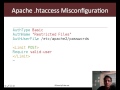 Http Verb Tampering Demo
-
 Web Application Pentesting Course Introduction
-
 Introducing Pentester Academy
-
 Hack Of The Day 13: Remote Shellcode Launcher: Testing Shellcode Over A Network
-
 Hack Of The Day 12: Pivots And Port Forwards In Scenario Based Pentesting
-
 Hack Of The Day: Customizing Shellcode For Fun And Profit
-
 Hack Of The Day: How Do I Run Untrusted Shellcode?
-
 Securitytube Linux Assembly Expert Exam Format
-
 [Slae] Writing An Custom Insertion Encoder
-
 [Slae] Execve Shellcode Stack Method
-
 [Slae] Shellcoding Basics
-
 [Slae] Using Libc And Nasm
-
 [Slae] Hello World In Assembly Language
-
 [Slae] What Is Assembly Language?
